Thursday, September 13, 2012


Blog 4: Graphic eTextbooks and the “Infinite Canvas”

In this blog, graphic textbooks is used as an all-inclusive term that includes both physical and digital formats. However, the term graphic eTextbooks refers exclusively to digital versions of these books. Since the majority of undergraduate textbooks are moving to digital platforms within five years it is unproductive to speculate on designing new paper-and-binding tomes. Therefore, the focus of my theorizing in regards to the content of these books will primarily focus on digital designs.

The first comic books adapted to the web appeared in situ. This is what Scott McCloud refers to as “a classic McLuhan-esque mistake of appropriating the shape of the previous technology as the content of the new technology.” (McCloud, 2009) This is a reference to Canadian educator and communication theorist, Herbert Marshall McLuhan (1911–1980). McLuhan predicted the World Wide Web thirty years before its inception, and claimed that “the medium is the message.” (Levinson, 1999, pp. 35-43; McLuhan, 1967) Currently, digital representations of comic books and graphic novels on the Internet are based on the needs of the physical medium and not the needs of the content. Comic book publishers need to have one foot in both “camps” for fear of losing traditional readers. The main problem with undergraduate graphic eTextbooks lies not in the medium, but in the academic rigor of the message. What has been forgotten by most publishers of graphic textbooks is that they are not graphic novels, and they do not share the same objectives. Whereas graphic novels seek to entertain, graphic textbooks primary objective is to teach. If we want to use graphic textbooks to teach undergraduate students then they need to conform to the same review process and academic rigor as any other undergraduate-level textbooks.
 
Though still narratives, graphic textbooks are not story-driven, per se, they are information-driven. With any textbook there is a beginning point and an ending point, and in between are chapters incrementally building on what was established previously. What textbooks do not (normally) have are story-arcs, character-arcs, climaxes, or dramatic dénouements. What graphic textbooks do differently than story-driven comic books and graphic novels is how they engage the reader. Many educational graphic textbooks contain a narrator either in the form of disembodied caption boxes, ala a documentary film, or as a drawn character(s) that breaks down the fourth wall to address the reader directly. For theater, the fourth wall is the space between the stage and the audience; for graphic narratives it is the space between the picture plane (either paper, or view screen) and the reader. The narrator, or “Chorus,” is a dramatic vehicle dating back to Greek theater, and has appeared in Shakespeare’s plays, television, and film. Some authors, like McCloud, use themselves as the narrator while others, like Jay Hosler in Evolution: The Story of Life on Earth, uses multiple characters who talk to each other in order to inform the reader (remember the term attitudinal instruction comics from Blog #1?).

The problem with transportability from static physical format to digital is that comic books and graphic novels need to fit within the viewing dimensions of an iPad, Kindle, Nook, or some other form of visual display device. This works fairly well for individual 3-tier pages even though the screen image is smaller than its physical counterpart. But while the traditional 32-page, 3-tier, 9-panel grid format has been the norm for print comic books since their inception it does not have to continue to be the dominant format moving into the post-print era—nor should it. The dimensions of the majority of digital comic books and graphic novels conform to their print counterparts. Politics, censorship, distribution networks, functionality, economics, and the basic limitations of print media have always controlled format, which in turn have dictated how stories are told and hampered creative growth, but that is not the case for the Infinite Canvas.

The Infinite Canvas was proposed by McCloud as a way of viewing sequential art via a monitor. (McCloud, 2000) For McCloud, the computer screen is not a snapshot of a single visual, but rather a window into the infinite that stretches out multi-dimensionally along the XYZ axis. This means that a linear story that scrolls through a long horizontal continues, uninterrupted, as it moves across the monitor screen towards its conclusion (or vertically as with a pdf). It also means that non-traditional storytelling techniques, such as true parallel narratives, or circular narratives can now be truly parallel or circular within the digital world. However, McCloud draws the line at introducing temporal phenomena such as embedded videos, hyperlinks, sound, animatronics, and the like, since they interrupt the continuity of presentation, because, in sequential art, space equals time, and that time is regulated by the viewer. (McCloud, 2009)


While McCloud’s personal belief may be true for graphic novels (and I emphasize the word “may” because such hard and fast “rules” stifle creative growth), such a statement is completely erroneous when it comes to graphic textbooks.

It is the hybridity of graphic narratives combined with the power of the Internet where I believe the true strength of graphic eTextbooks comes forth for two important reasons. First, the inclusion of temporal phenomena is no different from including sidebars or endnotes in a physical textbook. They exist spatially in time yet apart from the linear narrative, and when, or if, they are accessed by the reader that act is entirely within the reader’s control. Second, and this is, for me, the most significant aspect of the potential for all eTextbooks, because the introduction of those tangential elements reflect the way lessons are taught in a classroom.

Rather than present lessons on an uninterrupted continuum (because it's boring), teachers often include temporal phenomena to supplement their lessons. On any given day, whether I am teaching Photoshop or a course on Visual Culture, I will search for images, go to websites, watch videos, access a pdf, play a PowerPoint presentation, or simply look up information. These tangential elements are integrated into lessons to help students process information by engaging multiple senses thus increasing learning efficiency. Secondarily, by watching what I do via the SMART Board my students witness my problem-solving skills, and understand how I deductively solve a problem using the Internet, but even that can be integrated into the narrative of a graphic eTextbook via the “Chorus.”

With graphic eTextbooks the reader does control time spent with the temporal event by watching it multiple times, or skipping through it, or replaying certain segments, or not watching in it at all. While for some this may be antithetical to the continuity of traditional graphic narratives, the inclusion of temporal phenomena works perfectly with graphic eTextbooks through a form of expanded continuity. (Author’s term) For graphic eTextbooks, this is what McCloud refers to as A Durable Mutation, or rather a mutation from the physical sequential art medium into digital that has “some sort of staying power.” (McCloud, 2009) This form of Durable Mutation for graphic eTextbooks is actually no different from what many eTextbooks are already doing.


For purposes of making an analogy, if we borrow terms from biology’s taxonomic hierarchy, we might consider the family tree for comic strips, comic books/graphic novels, and graphic textbooks in this way. All three of these forms are of the same genus, graphic narratives, but all three are of a different species. Graphic novels and graphic textbooks are part of the same family tree, but evolving on different branches of it. Those differences, those tangential elements, those temporal phenomena that are antithetical to graphic novels because they interrupt the continuity of presentation, are part and parcel of teaching, and should be embodied in graphic eTextbooks (and if you have clicked on any of the links in this blog you have already helped prove my point). These differences that lend themselves so beautifully to how teachers teach are graphic eTextbooks’ Durable Mutation. The move to a digital platform will aid graphic textbooks in creating a virtual learning environment where they can evolve into a more robust educational tool.
 

Topics for Discussion

1) “I don’t buy it! Sequential narratives are linear and must always stay that way.”
2) “Okay, so if graphic textbooks have to become graphic eTextbooks this is what I would like to see included in their content.”


NEXT BLOG: Immersive Graphic eTextbooks as the Ultimate Scaffolding Tool

Tuesday, September 11, 2012


Blog 3: Educational Graphic Novels and the
Beginnings of Graphic Textbooks

Pictorial narratives are found rendered on the cave walls of Chauvet and Lascaux, France, scribed onto structures in ancient Egypt, carved into Trajan’s Column, illuminated into The Book of Kells, woven into the The Bayeux Tapestry, inlaid into the stained glass windows in the Cathedral of Our Lady of Chartres, and painted on the ceiling of the Sistine Chapel. Comic books, whether we wish to admit it or not, represent a natural progression of a visual storytelling tradition that has evolved over 40,000 years. The first printed short graphic narratives, ones that contain no more than a few dozen panels, appeared as early as the mid-Fifteenth Century in the form of religious propaganda. (Kunzle, 12-39) Other, short instructional graphic narratives described how a criminal was dismembered during an execution, or how to properly use instruments of torture in the Marshalsea Prison (Kunzle, 169, 194) Even though it is not sequentially illustrated, the Kama Sutra is really a visual instruction manual.

During World War II, Will Eisner utilized the sequential art concept for short graphic narratives in order to produced cartoons for Army Motors magazine. The cartoons were designed to educate soldiers on how to properly maintain their equipment and weapons. In 1951, The Department of the Army launched P*S, The Preventive Maintenance Monthly magazine. For twenty years Eisner acted as the artistic director for P*S, using sequential art as a teaching tool. P*S is still in publication, and celebrated its 700th issue in March of 2011. Considering that visual learners make up two-thirds of the population, it is baffling how few educational graphic novels and textbooks exist. Why is that, and why haven’t more publishers taken advantage of this untapped market?

From 19411962, Albert Lewis Kanter (18971973) published 167 issues in his highly popular Classics Illustrated line. Since then other companies have published illustrated versions of classic novels, but with minimal success. Except for a few authors like Stephen King (1947), Michael Chabon (1963), Ray Bradbury (1920–2012), and Stephenie Meyer (née Morgan, 1973) the majority of illustrated adaptations are for books in the public domain, so the authors do not have to be paid. Where are graphic adaptations of: Slaughterhouse-Five (1969), by Kurt Vonnegut, Jr. (19222007); Catch-22 (1961), by Joseph Heller (19231999); On the Road (1957), by Jack Kerouac (19221969); The Color Purple (1982), by Alice Walker (1944); Snow Crash (1992), by Neal Stephenson (1959); The Sun Also Rises (1926), by Ernest Hemingway (18991961); The Grapes of Wrath (1939), by John Steinbeck (19021968); To Kill a Mockingbird (1960), by Harper Lee (1926); Love in the Time of Cholera (1985), by Gabriel García Márquez (1927); The Catcher in the Rye (1951), by J.D. Salinger (19192010); Midnight's Children (1981), by Salman Rushdie (1947); or The Great Gatsby (1925), by F. Scott Fitzgerald (18961940)? Granted the “Classic” novels of sixty years ago are still considered “Classic,” but how many different graphic novel adaptations of Dracula (1897) by Abraham "Bram" Stoker (18471912) do we really need? By limiting illustrated adaptations to only public domain authors, younger readers are not being exposed to some of literatures’ greatest books at an earlier age, and educational possibilities are being lost.

However, educational graphic novels need not be restricted to maintenance manuals and novel adaptations. One of the earliest educational graphic novels printed in the United States was a Japanese import. Japan Inc., An Introduction to Japanese Economics (1988), by Ishinomori Shōtarō (19381998), was a 313-page Manga comic book published by the University of California Press. Japan Inc. was originally published in 1986 by the Nihon keizai shimbun, the Japanese version of The Wall Street Journal. The book brought “complex issues, facts, and figures into focus by personalizing and dramatizing them.” While it is out of date, it does provide an entertaining and interesting historical look at Reagan-era politics and economics.

Two of the most accessible areas for developing educational graphic novels are in the categories of biographies and historic non-fiction. One of the earliest creators of historic graphic novels is Timothy Truman (1956). Truman’s first two graphic novels, Wilderness: Book 1: The Borderland (1989), and Wilderness: Book 2: Bloody Ground (1991) concentrated on the eighteenth century American “renegade” Simon Girty. Truman followed these with Allan W. Eckert’s Tecumseh (1992), an illustrated adaptation of Eckert’s outdoor drama. In 1995, the popular writer of historical fiction and non-fiction, Morgan Llywelyn (1937) co-wrote Ireland: A Graphic History with Michael Scott (1959). The book, which had limited distribution in the U.S., was illustrated by Eoin Coveney and contains a Foreword by Will Eisner.

Cartoonist Larry Gonick’s (1946) educational graphic narratives take a humorous approach to teaching, and they can be considered some of the first popular mass-market graphic textbooks. Gonick, a Harvard-trained mathematician, is a prolific creator of  books such as Cartoon History of the United States (1991), Cartoon History of the Universe (Three Volumes, 19922002), The Cartoon History of the Modern World (Two Volumes, 20062009), and The Cartoon Guide to Calculus (2011).7 Some other books that also follow this method are Action Philosophers (Three Volumes, 20062007) written by Fred Van Lente (1972) and drawn by Ryan Dunlavey; Still I Rise: A Cartoon History of African Americans (1997) by author Roland Laird and artist Elihu Bey; and The Stuff of Life: A Graphic Guide to Genetics and DNA (2009) by author Mark Schultz (1955) and illustrated by Zander Cannon (1972) and Kevin Cannon. Essentially, all of these books are primers, but they provide a fun introductory course for pre-college students.

Joe Sacco has carved a very impressive niche for himself as a graphic journalist with his work on Palestine (2001) and Safe Area Goražde: The War in Eastern Bosnia 199295 (2002). Sacco does what every good journalist is supposed to do – he puts a face on the story. In terms of reportage, Fax From Sarajevo by Joe Kubert (1926), and The 9/11 Report: A Graphic Adaptation (2006), by Sid Jacobson (1929) and Ernie Colón (1931), are also of importance to the educator.

The historically-based graphic novel From Hell (1999), by writer Alan Moore and artist Eddie Campbell (1955) is of special interest because of the amount of research that went into its production. It is a massive 572-page volume that contains a 42-page appendix annotating all of Moore’s research. Mixing fact, conspiracy theory, and educated speculation, From Hell is an examination of the Jack the Ripper murders, and a critical commentary on Victorian England. Though not strictly factual, Moore shows us that it is possible to teach and entertain at the same time.
 

Astonishingly, there are very few graphic novels/textbooks about art or art history. Aside from Will Eisner’s and Scott McCloud’s books on sequential art, and a few publications about the lives of cartoonists, the rest of the art world is left fallow. For example, why are there no graphic novels/textbooks about the history of fashion? Think of how visually stunning that could be! The single most surprising publisher of the best art-related graphic novels is the Office of Cultural Development, Musée du Louvre – The Louvre Museum in Paris. To date, there are four books translated into English: Glacial Period (2007), by Nicolas de Crécy; The Museum Vaults: Excerpts From the Journal of an Expert (2007), by Marc-Antoine Mathieu; and On The Odd Hours (2010), by Eric Liberge (1965). Each of the books explores the museum from a different, sometimes fanciful aspect.

The Louvre’s fourth book, The Sky Over the Louvre (2009 in French & 2011 in English), written by Jean-Claude Carriere (1931) and illustrated by Bernard Yslaire, is an important work. Set in the tumultuous years of the French Revolution, The Sky Over the Louvre is the story of the beginnings of the Museum told through the lives of political theorists Maximilien François Marie Isidore de Robespierre (17581794), Jean-Paul Marat (1743–1793), and painter Jacques-Louis David (17481825). What is distinctive about this book is that the author, Carriere, is the former president of La Fémis, the French state film school, and is the screenwriter of many incredible movies including: Danton (1983), The Return of Martin Guerre (1982), The Unbearable Lightness of Being (1988), and Valmont (1989). With educational graphic novels and textbooks there is a dearth of product and a wealth of opportunity.
 

Educational Graphic Textbooks for Undergraduates

            In the past decade, the graphic novel format has grown in acceptance among college and university academicians as an educational medium (Goggin and Hassler-Forest, 2012, p. 3). Since the 1970s, the prevailing trend has been to utilize pre-existing graphic novels as literature, rather than develop new ones aimed specifically for use in the classroom. This trend is slowly changing, predominately in the area of the sciences, with the publication of sequential art textbooks such as Optical Allusions (2008) by Jay Hosler; Charles Darwin's On the Origin of Species: A Graphic Adaptation (2009) by Michael Keller and Nicole Rager Fuller; and Evolution: The Story of Life on Earth (2011) by Jay Hosler, Kevin Cannon, and Zander Cannon. Admittedly, the research for new graphic textbooks is time consuming, so one has to wonder why certain books, such as A Brief(er) History of Time (1998, 2008) by Stephen William Hawking (1942–), has not yet been adapted into a sequential art format.
 
            The Magic of Reality: How We Know What’s Really True (2011) written by evolutionary biologist Richard Dawkins (1941–), and illustrated by noted film director, graphic novelist, and cover artist for the popular Sandman comic book series, Dave McKean (1963–), while not sequentially illustrated, is impressive because of how it visually engages the reader. Due predominantly to Dawkins’ popularity this book has not gone unnoticed by book reviewers (as is the case, unfortunately, with most graphic textbooks).  The September 23, 2011, issue of The Chronicle Review cites Dawkins as one of “a growing band of scientists and science writers who are making use of the comic-book format—one that can ‘give accurate information and make it exciting.’” While this statement is true for The Magic of Reality, it also reflects why graphic textbooks work so well as a teaching tool—because they captivate students by making the mundane stimulating!

 
Topics for Discussion

Your comments are important to me (!), and will help me understand ways of developing multi-departmental graphic textbooks. Please click on the Comment button below, and share your thoughts! If you do not have a Google, LiveJournal, WordPress, TypePad, AIM, or OpenID account you may email me at kane.112@osu.edu, and I will post your comment(s) for you either anonymously, or with your name (whichever you prefer).
 
1) Why these illustrated texts gaining so much credibility as a teaching tool in the more structured, quantitative fields of math and the sciences, and why are they not evolving as quickly in other disciplines?

2) How can an understanding of how students learn and retain information from math and scientific graphic textbooks aid in the conceptualization and creation of other undergraduate-level educational graphic textbooks in other disciplines?

NEXT BLOG: Graphic eTextbooks and the “Infinite Canvas”

Thursday, September 6, 2012


Blog 2: Graphic Novels Are Not Literature

Lit•er•a•ture: noun
1.   writings in which expression and form, in connection with ideas of permanent and universal interest, are characteristic or essential features, as poetry, novels, history, biography, and essays.
—www.dictionary.com


Before we can discuss what Graphic Textbooks are we need to understand their origin, which means we have to understand where the term “Graphic Novel” came from.
Originally conceived as a term that would define longer works of sequentially illustrated stories containing mature themes, graphic novel has become an umbrella phrase, a marketing tool for almost any work told through the use of pictures. Simply put, the term graphic novel has devolved to mean any illustrated story. Yet, that really is too broad of a description to have any well-defined meaning.
 
If we conclude that a graphic novel must include text (words), then how do we categorize Shaun Tan’s (1974) The Arrival (2006)? If we maintain that the artwork can only be sequential, then where do we place Jim Steranko’s (1938) Chandler: Red Tide (1976)? If we insist that the story consists of only one narrative then what is Will Eisner’s (19172005) A Contract with God and Other Tenement Stories (1978)? And if we demand that a graphic novel must be exclusively original and not one that was initially serialized in a magazine, then should we not exclude Art Spiegelman’s (1948–) Pulitzer Prize-winning Maus: A Survivor’s Tale (1986 & 1991) from our list? 

These questions exist because of our common need to categorize everything, because of the physical and financial limitations of printing and binding, and because of Library Science’s requirement to catalog books into an antiquated classification system. In truth, the academic discourse on graphic novels, which has been almost wholly literary, has been viewed from a skewed perspective.

Graphic novels were never literature’s bastard children, but that is how they have been—and are still—perceived in some academic circles. Comparable to film, graphic novels are a visual medium and apart from literature in much the same way film is apart from literature. In truth, graphic novels have never been a form of literature, but they have always been an independent literate art form. To elucidate the dissimilarity, if one can convert a published work into an audio book by reading just the text, without losing any of the story’s nuances and meanings, then it is literature. This test holds true for works of prose, poetry, and plays, but not for graphic novels or film because so much of the story is conveyed visually.

This does not mean that graphic novels should no longer be read in literature or other classes because the needs of the lesson outweighs the format of the pedagogical vehicle; however, it does illustrate society’s persistent problem with accepting graphic novels because of this miss-association. Comic books became trapped in a format and vernacular that has biased the public’s perception since their inception. However, if we look at the Storytelling Family Tree we see that pictoglyphs, petroglyphs, oral tradition, literature, film, and graphic novels are all simply narrative vehicles growing out of the same trunk. Contemporary Graphic Narratives [comic books, graphic novels, comic strips, children’s picture books, certain forms of illustrated books such as Dinotopia (1992) by James Gurney (1958–)] grew apart from their cousins to form their own branch of the Storytelling Family Tree. Because of their visuality, the questions surrounding graphic novels should never have been: “Are they, or are they not literature?” The questions should have focused on “How can we cultivate the graphic novel format in order to tell better stories?” By asking these types of questions, by “troubling the binary” as it were, we acknowledge that graphic novels are a distinctive medium—a distinctive art form—set apart from both literature and film.

Unfortunately, removing graphic novels from the literary tradition is problematic because there is no viable way to adequately market them to academicians other than book review publications such as Booklist, Publisher’s Weekly, and Library Journal to name a few. Removing them from the literary tradition would also negate the literary awards they have already received, and make them ineligible for future awards. Yet, there is already a double standard at work here. While graphic novels have been considered for literary awards, such as a Special Pulitzer Prize and the World Fantasy Award, there has never been a text-only book that was considered for any of the graphic novel honors such as the Eisner Award or the Harvey Award. It is, however, vitally important to separate graphic narratives from literature because the comparison stifles growth and creativity. By understanding that they are an art form independent from literature, graphic narratives no longer need to fit into the narrow confines of form and format that has been imposed upon them. It means that they can freely evolve as the creators envision them through a process of artistic growth.


The Origin of the Term, and the First Modern Day Graphic Novel

Contrary to popular belief, Will Eisner’s A Contract with God and Other Tenement Stories was not the first time the term graphic novel was used, nor is it the first modern graphic novel. The first printed usage of the term appeared in Richard Kyle’s November 1964 newsletter published in CAPA-ALPHA #2 (Fingeroth, 2008, 3). Previous derivations on the theme such as “Picture Novel,” and “Picto-Fiction” appeared on paperbacks and magazines in the 1950s. The first Picture Novel, and, arguably, America’s first graphic novel was It Rhymes with Lust (1950). The digest-sized, 128-page book was produced by St. John Publications (19471958), which was founded by Archer St. John (19041955). It Rhymes With Lust was written by Arnold Drake (19242007) and Leslie Waller (19232007) under the pseudonym “Arnold Waller,” drawn by Matt Baker (19211959), and inked by Ray Osrin (19282001).

Baker was one of the medium’s first African American artists, and one of the forerunners of the “Good Girl Art” movement, working on titles such as Phantom Lady, and Sheena, Queen of the Jungle. Inspired by film noir, It Rhymes With Lust was a character-oriented romance/detective story. Though the story is typical of genre films of its time, It Rhymes With Lust also contained an underlying social commentary about greed, graft, and worker’s rights. St. John’s second graphic novel was The Case of the Winking Buddha (1950), by novelist Manning Lee Stokes (19111976) and illustrator Charles Raab. Unfortunately, both of these books failed financially, and the format was abandoned (Kitchen, 2011).

Though it may be considered a collection of short stories, Harvey Kurtzman’s Jungle Book (1959) is the prototype for the graphic anthology format. Jungle Book was written and illustrated by Harvey Kurtzman (19241993), who was the founding editor of MAD (1952) magazine. Kurtzman was a highly influential creative force in the comics industry, and helped shape much of America’s popular culture during the 1950s (Wright, 2003). Jungle Book was a commercial failure; however, it had a tremendous impact on the Underground Comics artists of the 1960s (Kitchen, 2011).

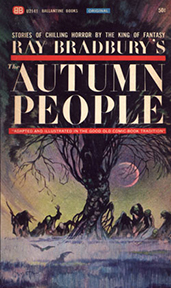
Another forgotten series of books from the mid-1960s, are the Ballantine Books paperback reprints of Mad magazine and the EC Comics line of early 1950s horror stories. Because paperbacks were not sold with comic books they did not come under the scrutiny of the Comics Code Authority and its restrictions. Among these titles were, Autumn People (1965) with stories by Ray Bradbury (1920–) adapted by Albert “Al” B. Feldstein (1925–), The Vault of Horror (1965), Tales From the Crypt (1964), Tales of The Incredible (1965), and Dracula (1966). While the other books contained reprints, Dracula was an all-new adaptation of “The great horror classic illustrated in comic book form!” Produced by Russ Jones (1942–), the text for Dracula was adapted by Otto Oscar Binder (1911–1974) and Greg Tennis (Nom de plume for Johnny Craig [1926–2001]), illustrated by Alden “Al” McWilliams (1916–1993), and contained an Introduction by Christopher Lee (1922–). Another, similar volume, albeit printed by Pyramid Books, was Christopher Lee’s Treasury of Terror: Great Picture Stories of Supernatural Horror (1966). As with Dracula, the Christopher Lee book was produced by Russ Jones, but was an anthology of stories selected by Lee, and adapted by various writers and artists. None of these books sold well enough to warrant subsequent volumes; however, Dracula was, historically, the third graphic novel (following It Rhymes With Lust, and The Case of the Winking Buddha) and the Christopher Lee book was the second anthology of original work following Jungle Book.

By the early 1970s, the term graphic novel was part of the comics creator’s vernacular; however, it was not used to describe America’s next attempt at a graphic novel, Blackmark (1971). Blackmark was conceived by Gil Kane (aka Eli Katz 19262000), written by Archie Goodwin (19371998) and illustrated by Kane over uncredited pencil layouts drawn by Kurtzman (Kitchen, 2011). Published by Bantam Books, Blackmark was a 119-page science fiction/sword and sorcery heroic fantasy graphic novel printed in a traditional paperback format. While conceived as the first in a sequence of ongoing graphic novels, sales of the first volume were poor, which led to the cancellation of the series.

The first self-referential use of the term graphic novel appeared on the January 1976 publication Schlomo Raven. Written by Byron Preiss (19532005) and illustrated by Tom Sutton (19372002), Schlomo Raven also contained an Introduction by Kurtzman. Printed in large bold letters on the back cover of the digest-sized paperback were the words “—VOLUME ONE OF AMERICA’S FIRST ADULT GRAPHIC NOVEL REVUE!” Schlomo Raven was the first in Pyramid Books’ Fiction Illustrated series aimed at a more mature audience. The series also included: Starfawn (1976), by Byron Preiss and Stephen Fabian (1930); Chandler: Red Tide, by Jim Steranko; and Son of Sherlock Holmes: The Woman in Red (1977), by Bryon Preiss and Ralph Reese (1950? –). Even though Schlomo Raven was published twenty-one months before A Contract with God, its place in graphic novel history has been largely overlooked along with the other Fiction Illustrated volumes. In their day, the odd format and sporadic paperback distribution made them curiosities among comic fandom buyers who did not appreciate change (Steranko, 2010). When combined with the fact that none of these volumes has ever been reprinted (mainly due to legalities resulting from the death of Preiss), and that the stories, except for Chandler, are only of cursory interest, it is not surprising that they have been forgotten.

Other graphic novels soon followed, including: Robert Ervin Howard’s (19061936) Bloodstar (1976), adapted by illustrator Richard Corben (1940); Beyond Time and Again: A Graphic Novel (1976), by George Metzger (1939); Sabre: Slow Fade of an Endangered Species (1978), by writer Don McGregor (1945) and artist Paul Gulacy (1953); The Silver Surfer (1978), by Stan Lee (1922) and Jack Kirby (19171994); The First Kingdom (1978), by Jack Katz (1927); Comanche Moon (1979), by Jaxon (Jack Jackson, 19412006); and Tantrum (1979), by Jules Feiffer (1929). 

The critically acclaimed A Contract with God was the first modern graphic novel to deal exclusively with the human condition. It revolutionized the comics industry by becoming the first commercially successful graphic novel (Kitchen, 2011). While some detractors claim that A Contract with God is actually a collection of short stories, and not a novel per se, the use of multiple stories with an underlying connective theme is not without precedent, and is the basis for books such as Winesburg, Ohio (1919) by Sherwood Anderson (18761941), and The Wild Palms [If I Forget Thee, Jerusalem] (1939) by William Faulkner (18971962). Its longevity and continued popularity speaks to its broad market appeal and timeless stories. Additionally, its semi-autobiographical approach established a standard by which all other slice-of-life graphic novels are compared. Even though Eisner did not invent the term graphic novel, its use on the cover of A Contract with God popularized it, and brought it into public forum (Kitchen, 2011).


Topics for Discussion

1) This is a bunch of hooey. Graphic novels are literature because…

2) The public’s acceptance of graphic novels has increased over the past decade. What factors would you attribute to that change?

3) What is missing from this review of the literature?

Tuesday, September 4, 2012


Blog 1: Developing Graphic Textbooks for Undergraduate Study

            It is my opinion that one day introductory-level educational graphic textbooks for college students will be the norm rather than the exception. As part of my Ph.D. dissertation, I have created this blog in order to explore ways to achieve that goal. For the next six weeks I will make two blog posts per week (Tuesdays and Thursdays) covering various topics for the public to read, and critique. In this way it is hoped that educators, students, publishers, and the creative community will use this as a forum to help set academic standards for the development of future undergraduate-level educational graphic textbooks.

Please feel free to share this link with your colleagues!!!
 

A (Very) Short History of Graphic Textbooks

            Since most of you already know what Sequential Art is I will skip over much of the history of the medium (for now). While working on his book, Comics and Sequential Art (1985), Eisner, who was in his mid-sixties and had been illustrating comic stories for fifty years, realized that he “was involved in an ‘art of communication’ more than simply an application of art,” (Eisner, 1985, 6) and that “thoughtful pedagogical concern would provide a better climate for the production of more worthy subject content and expansion of the medium as a whole.” (Eisner, 1985, 5) At the time Comics & Sequential Art was written graphic novels were still in their infancy, and Art Spiegelman’s Maus had yet to win a Pulitzer Prize. However, Eisner understood the potential power of the medium, and concluded that “the future of this form awaits participants who truly believe that the application of sequential art, with its interweaving of words and pictures, could provide a dimension of communication that contributes—hopefully on a level never before attained—to the body of literature that concerns itself with the examination of human experience.” (Eisner, 1985, 138-139)

            Even though Eisner’s focus was on entertainment comic stories, he also illustrated both technical instruction comics, and attitudinal instruction comics, which are the precursors to graphic textbooks. (Eisner, 1985, 138-142) Technical instruction comics are illustrated instruction manuals such as directions for putting together a bicycle. These teaching aids are meant to involve the reader through explanatory text and images drawn from the reader’s perspective. Technical instruction comics are an experiential learning tool that helps the reader though a sequence of events in order to perform tasks to completion. Attitudinal instruction comics are dramatizations of events such as “How to get a job.”  The concept behind attitudinal instruction comics is to visually and dramatically show readers situations that they have not yet experienced. Japan, Inc.: Introduction to Japanese Economics (1988), a dramatic look at President Reagan-era politics and economics, follows this schema, and many young reader’s books over the years such as A Visit to the Doctor (1960) and Loose Tooth, My First I Can Read (2005) can also be considered attitudinal instruction comics. 

            In 1993, Understanding Comics: The Invisible Art by Scott McCloud answered Eisner’s wish for a more “thoughtful pedagogical concern” with a deconstructive instructional graphic textbook that utilized sequential art in order to explain sequential art. Understanding Comics was the first attempt at popularizing the idea of graphic textbooks. In it McCloud defines the art of comic books as, “juxtaposed pictorial and other images in deliberate sequence, intended to convey information and/or to produce an aesthetic response in the viewer.” (McCloud, 1993, 9) While this is a more precise definition of the art form, it is too cumbersome for purposes of this paper, so I will continue using Eisner’s term sequential art instead. It should be noted that neither term/definition mentions the use of text, which, for a graphic textbook, especially one designed specifically for undergraduate students, is problematic. Though wordless panels may be used sparingly for dramatic effect, the definition for sequential art, as it relates directly to undergraduate-level textbooks, must include the implicit mandate that the information being taught is achieved through the use of visual art accompanied by complimentary text, juxtaposed text, or parallel text.

            In Heidi Hammond’s book, Graphic Novels and Multimodal Literacy: A Reader Response Study (2009), she states in her Review of the Literature that there are few academic studies regarding educational graphic novels because they have such a short history (Hammond, 2009, p. 42).  Currently there are very few educational graphic textbooks available for teaching students at the undergraduate level. Considering the increased interest in biographical, autobiographical, and journalistic graphic novels among college and university instructors (The Chronicle Review, September 23, 2011), the educational graphic textbook is an underutilized pedagogical tool.

            Over the past several years a few graphic textbooks have been published that have supported my belief in the pedagogical potential of this medium. Some of these are Optical Allusions (2009) by Jay Hosler, Ph.D.; Charles Darwin's On the Origin of Species: A Graphic Adaptation (2009) by Michael Keller, and Nicolle Rager Fuller; Evolution: The Story of Life on Earth (2011) by Jay Hosler, Ph.D., Kevin Cannon, and Zander Cannon; DNA: A Graphic Guide to the Molecule that Shook the World (2011) by Israel Rosenfield, Edward Ziff, and Borin Van Loon; and The Cartoon Introduction to Economics, Volume One: Microeconomics (2010) and Volume Two: Macroeconomics (2011) by Yoram Bauman, Ph.D., and Grady Klein. While some of these graphic textbooks can be used (and have been used) to teach undergraduates the quality of the scholarship in other graphic textbooks currently being published is uneven. I believe that this inconsistency in scholarship should not be seen as a detriment, but rather as an opportunity.

Topics for Discussion

Your participation is greatly appreciated. Please understand that whatever is posted here may end up in my dissertation and/or future writings on this subject. If you do not wish to be included then do not post anything. Thank you!

Questions or concerns regarding this research may be addresses to dissertation advisor, Dr. Candace Stout at stout.127@osu.edu, or Brian Kane at kane.112@osu.edu. For questions about your rights as a participant in this study or to discuss other study-related concerns or complaints with someone who is not part of the research team, you may contact Ms. Sandra Meadows in the Office of Responsible Research Practices at 1-800-678-6251.).


1) While I would consider The Stuff of Life: A Graphic Guide to Genetics and DNA by Mark Schultz, Zander Cannon, and Kevin Cannon appropriate for Honor and Advanced Placement High School students, neither Mark nor I consider it suitable for college-level students because of the lack of academic rigor that went into its production. Other than the books listed above, what other undergraduate-level graphic textbooks should be added to the list and why?

2) What standards (checks and balances) need to exist in order to guarantee the academic credibility of graphic textbooks?

3) Once academic standards are established how do we convince publishers to adopt them? What would be the protocols for peer review of graphic textbooks?